

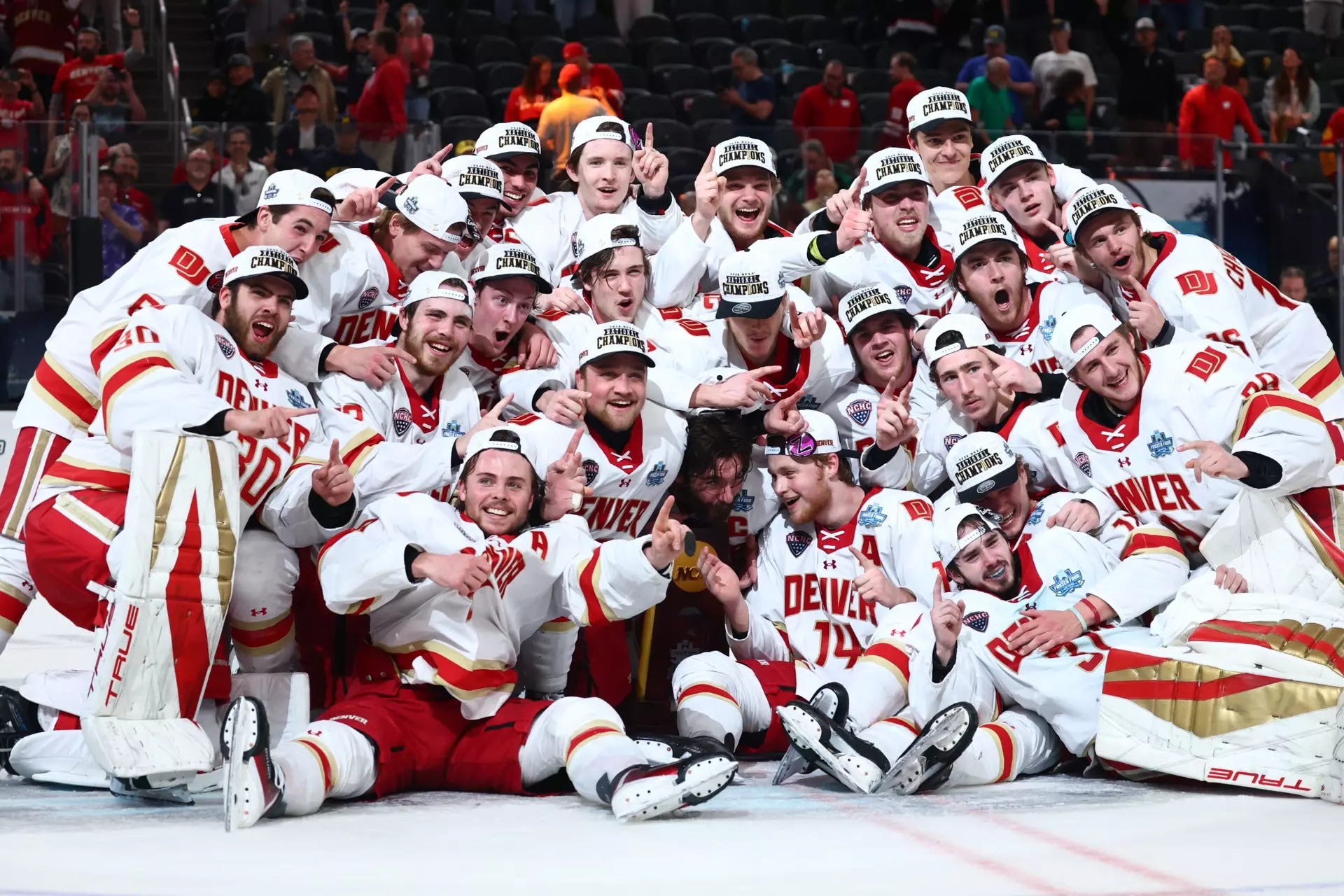
The easy story to tell about the Denver Pioneers is that they won another national championship.
Three in five years.
Eleven total; more than any other team.
A dynasty by any measure.
All true.
But it misses the point.
What stood out wasn’t the result.
It was the courage.
A Run Built on Edges
This wasn’t dominance.
It was survival, over and over again.
Three overtime wins in their last eight games.
Two in double-overtime.
In the NCHC semifinal, down late against Western Michigan, they score to force overtime.
In the final against Minnesota Duluth—again, overtime. The Pios win both games.
Then the national semifinal against the University of Michigan Wolverine—the No. 1 team in the country and tournament favorite.
Down late.
The Pios score late.
Overtime again. Double-overtime.
They win that one, too.
Nothing about those moments suggests control.
And yet, internally, they never lost it.
The Temptation
Pressure doesn’t just test skill.
It tests identity.
When you’re trailing late…
When the game speeds up…
When the margin disappears…
The instinct is to reach.
To press.
To force something that isn’t there.
To abandon structure in favor of urgency.
That’s how games unravel.
They Didn’t
Call it “rope-a-dope,” as some did.
Disciplined.
Relentless on the backcheck.
Active sticks.
Connected, team-first hockey.
Not flashy.
Not reactive.
Not emotional.
Just consistent.
They absorbed pressure.
Waited for mistakes.
And capitalized when they came.
Most importantly:
they played that way regardless of the score, regardless of the stage of the game.
Already Decided
By the time they faced the Wisconsin Badgers in the national championship game, the outcome was already shaped.
Not fully decided.
But shaped.
Because the Pios identity had already been forged under stress.
Down 1–0 after two periods.
A familiar position.
The announcers said they looked tired, panicky on the bench.
Wrong.
No panic.
No deviation.
They tied it at 7:31 of the third.
Took the lead at 14:08.
Same approach.
Different moment.
Same response.
This Isn’t About Hockey
It’s easy to call this composure.
Or resilience.
Or toughness.
Those are downstream labels.
What you’re actually seeing is alignment.
They know how they play.
They trust it.
And they don’t negotiate with it when it gets hard.
That’s the lesson.
The Inside Game
Pressure doesn’t reveal character.
It reveals whether you trust the one you have.
Not abstractly.
In action.
Do you know how you operate at your best?
Have you built it deeply enough that it holds under stress?
And when the moment comes—
do you have the courage to stay there?
Because that’s the real test.
Not knowing what works.
But trusting it when it’s not working yet.
When you’re down late.
When nothing is breaking your way.
When urgency is pulling you to abandon it.
Most people don’t fail from lack of capability.
They fail from lack of alignment.
They drift.
They chase.
They negotiate with their own standards.
The Pioneers didn’t.
The Quiet Advantage
Late in any difficult stretch, the external situation stops being the real risk.
Internal drift is.
You move away from what works.
You react instead of execute.
You trade identity for urgency.
That’s when things break.
That’s when you make mistakes.
The Pioneers showed us how to avoid that.
They stayed inside their game.
And when the moments came—
that consistency delivered results.
The Takeaway
Winning isn’t the lesson.
Alignment is.
When you know how you operate at your best,
and you trust it enough to stay there under pressure,
results stop being something you chase.
They become something that emerges.
In this case: another national championship for the Denver Pioneers.