

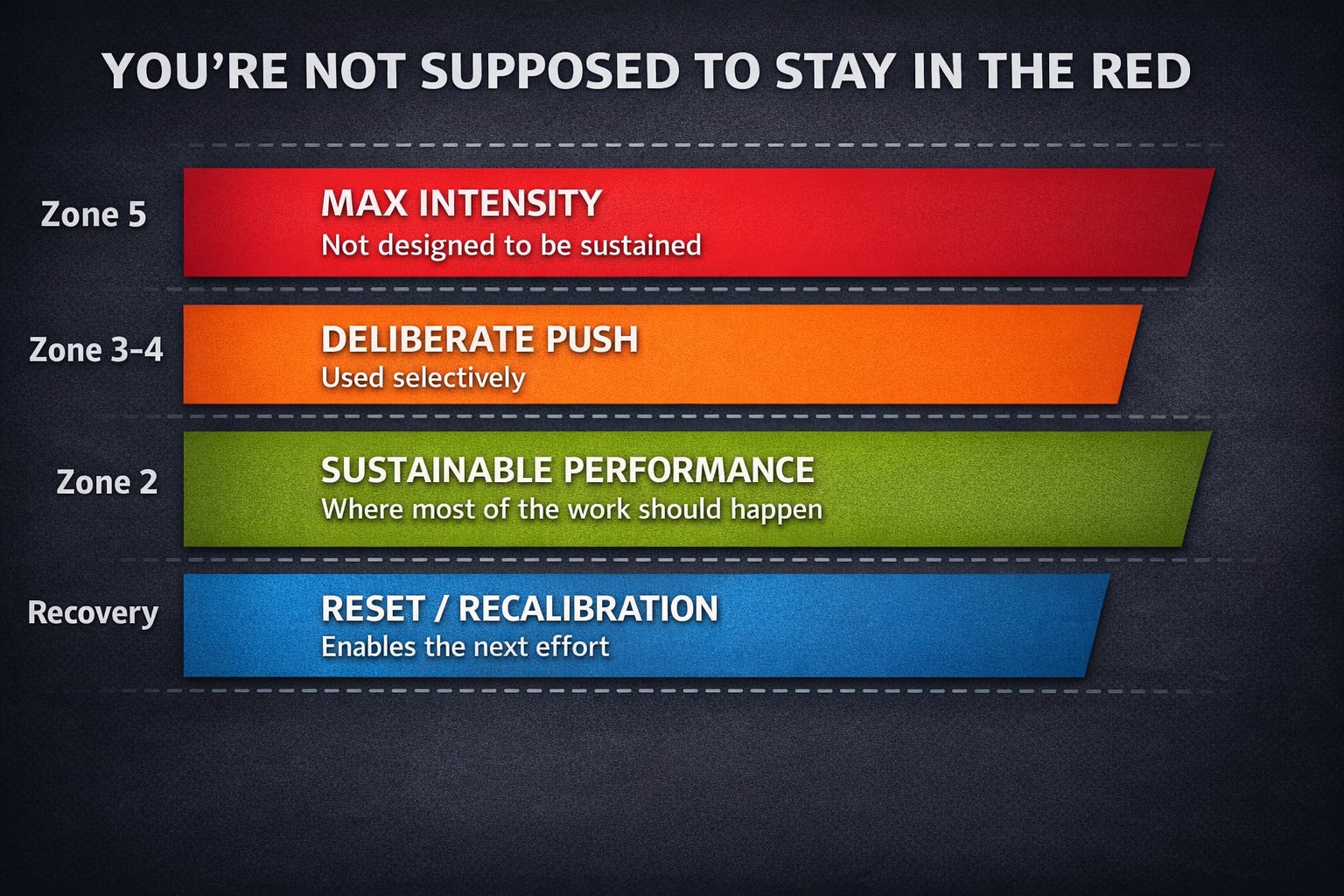
High performance isn’t just about how hard you can push.
It’s about how well you manage intensity over time—individually and organizationally.
Most leaders get this wrong.
They treat intensity as the default state—instead of a tool to be used deliberately.
Over time, that doesn’t just wear down the individual. It wears out the organization.
What starts as situationally driven urgency becomes a default mode. What begins as drive becomes an unsustainable expectation.
This isn’t culture, it’s bravado. And if not moderated, the system degrades from operating in a state it lacks the capacity to sustain.
The Intention of Progressive Endurance Training
I spend a lot of time on a rowing machine.
One of my favorite sessions is my weekly progressive row:
50 minutes in Zone 2.
15 minutes of moderate intensity (pushing toward discomfort).
15 minutes of high-intensity (fully in it).
Then 10 minutes of active recovery.
It’s simple. Structured. Repeatable. And it drives significant adaptive changes in physiology.
The progressive is one of the clearest physical analogs I’ve found for leadership under load.
Each Phase Has a Purpose
Zone 2 is where most of the work happens.
It’s not easy.
It’s a controlled, steady effort.
You’re engaged. You’re under load. But you can sustain it.
This is where efficiency builds.
Where technique refines.
Where output compounds.
Then you push.
First toward discomfort—moderate intensity, still controlled, deliberate. Maintaining cadence and form.
But then, for a period, fully into it.
Heart rate rises.
Breathing cadence increases.
Everything is engaged.
Maintaining cadence and form hinges on intention, not rhythm.
The high-intensity push is where you access capacity you can’t reach otherwise.
But that phase is not meant to last. It only works because it’s bounded. And because it’s followed by recovery. Not stopping, but flushing the strain of the high-intensity push. Resetting.
You keep moving while the system clears what has built up under load.
Heart rate comes down. Breathing stabilizes. Lactic acid breaks down.
So you can go again in the next row.
Where Leadership Breaks Down
Running a company should follow the same pattern.
Long stretches of steady execution.
Moments that require approaching discomfort.
Periods where the stakes are high, and intensity is necessary.
But many leaders collapse these phases into one. They operate as if intensity is the job; the default mode.
Always pushing.
Always in discomfort.
Always treating urgency as the baseline.
This can work for a while.
But it’s not sustainable, so eventually cadence, form, and consistency deteriorate.
With that comes a degradation in output, energy, and clarity. Because urgency and importance aren’t the same thing
Decision quality slips.
Reactivity increases.
Everything begins to feel heavier than it should.
Because the system is in perennial overload. The organization “bonks”.
You Have to Know What Phase You’re In
In training, you don’t guess.
You know the phase.
You know its purpose.
And you know its duration (unless you're on a Fartlek).
The intention is what makes it effective.
Leadership requires the same awareness.
If you’re pushing, it should be intentional, not de facto.
You should know why the moment calls for it.
And you should know when it ends.
Without that, intensity stops being a tool
and becomes a condition.
And once it becomes a condition,
individual and organizational effectiveness suffer.
Most of the Work Is Meant to Be Sustainable
The highest-performing systems aren’t built on constant intensity.
They’re built on sustainable effort.
Clear thinking.
Consistent execution.
Measured progress over time.
It’s the compounding power of Zone 2.
It shouldn’t feel dramatic.
It shouldn’t look like strain.
But it’s what allows intensity to be applied effectively when it’s needed.
Intensity Without Structure Degrades Performance
This “always on intensity” version of leadership is flawed because it equates constant intensity with commitment.
Full on all the time.
Pushing.
At the edge of effort.
It gets rewarded—especially in high-demand environments.
But it’s not discipline. It’s a lack of structure.
Because real discipline requires constraint.
Knowing when to push—and when to step out of it so the next effort is effective.
Physiologically, if you don’t allow the system to clear what builds under load, performance drops. You bonk.
In organizations, the same thing happens.
Not just fatigue—distortion.
Shortened time horizons.
Reactive decision-making.
Loss of perspective.
Sustainable Performance Is Structured
The point of a progressive row isn’t just to work hard.
It’s to work across phases with intention.
To apply the right level of intensity at the right time.
And to reset in a way that makes the next effort possible.
Leadership is no different.
Sustainable individual and organizational performance is built on consciously applied intensity—
not constant intensity.
That requires awareness:
What phase are we in?
What does this moment require?
And how long did we decide it would last?
Getting Out of the Red
You’re not capable of staying in the red.
You have to know when you’re there.
Why you’re there.
And when it’s time to come out.
That’s what makes the next push possible on any high-demand effort, whether it’s high-performance endurance athletics or company building.